ToysRequirementsForWaterBeads_Supporting Statement Part A_2025
ToysRequirementsForWaterBeads_Supporting Statement Part A_2025.docx
Safety Standard for Toys: Requirements for Water Beads
OMB: 3041-0206
SUPPORTING STATEMENT - PART A
Safety
Standard for Toys:
Requirements for Water Beads
OMB
Control Number 3041-0206
1. Need for the Information Collection
The U.S. Consumer Product Safety Commission (CPSC or Commission) has promulgated a final rule that sets forth requirements for water bead toys and toys that contain water beads. 90 FR 57820 (Dec. 12, 2025). This rule contains information collection requirements that are subject to public comment and review by the Office of Management and Budget (OMB) under the Paperwork Reduction Act of 1995 (PRA; 44 U.S.C. 3501–3521). The Commission is authorized to issue this final rule pursuant to both section 106(c) and (d) of the CPSIA. 15 U.S.C. 2056b(c) and (d).
The Commission currently mandates that toys comply with the requirements of ASTM F963, which includes performance requirements and test methods for toys, as well as requirements for warning labels and instructional literature, to reduce or prevent injury to children or death of children from mechanical, chemical, and other hazards associated with toy use. Toys must comply with this standard pursuant to 16 CFR part 1250.
CPSC staff identified 64 incidents in the Consumer Product Safety Risk Management System (CPSRMS) from 2017 through 2023 associated with the use of water bead toys. Staff identified the following incident data hazard patterns associated with water bead toys: ingestion, ear insertion, nose insertion, aspiration, and choking. The incident data and hazard patterns cited support the information collection requirements of the final rule.
Incident data demonstrate that children ingest water beads, aspirate and choke on them, or insert them into the nose or ear, and subsequently suffer injury or death. Staff’s testing of water bead toys further demonstrates that tested water beads that pass the performance requirements in ASTM F963–23 can still pose safety hazards. Accordingly, this rule under section 106 of the Consumer Product Safety Improvement Act of 2008 (CPSIA) creates additional requirements in part 1250 to establish mandatory requirements specifically for water bead toys.
2. Use of the Information
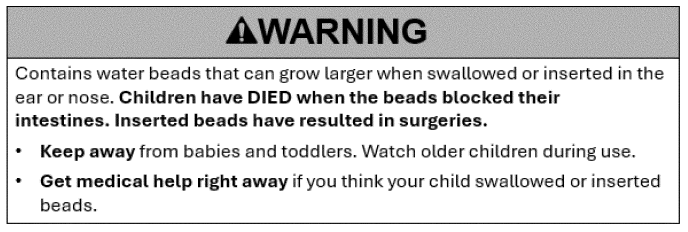
Section 1250.4 provides the marking, labeling, and instructional literature requirements for water bead toys. This section establishes performance and labeling requirements for water bead toys and toys containing water beads to minimize the risk of children ingesting, inserting, aspirating, and choking on water beads. (See Figure 1.)
Figure
1: Warning for Water Bead Toys and their Packaging
3. Use of Information Technology
On-product warnings are not digital in nature; however, CPSC staff utilizes appropriate forms of information technology, such as electronic communication, to reduce unnecessary burden.
4. Non-duplication
The information obtained through this collection is unique and is not already available for use or adaptation from another source.
5. Burden on Small Businesses
Most of the U.S.-based manufacturers and importers of water beads are small companies based on Small Business Administration (SBA) size standards. This information collection could have a significant impact on small entities.
To reduce the impact of the final rule on small firms, CPSC provides a variety of resources to help both new and experienced small businesses learn about safety requirements that apply to consumer products, including the CPSC Regulatory Robot and small business education videos. Many of these resources can be accessed online at: https://www.cpsc.gov/Business--Manufacturing/Small-Business-Resources.
6. Less Frequent Collection
If the information collection is conducted less frequently this could reduce the effectiveness of the requirements.
7. Paperwork Reduction Act Guidelines
This collection of information does not require the collection to be conducted in a manner inconsistent with the guidelines delineated in 5 CFR 1320.5(d)(2).
8. Consultation and Public Comments
Part A: PUBLIC NOTICE
The preamble to the Notice of Proposed Rulemaking (NPR) discussed the information collection burden of the rule and specifically requested comments on the accuracy of CPSC’s estimates. 89 FR 73045 (September 9, 2024). The NPR described the provisions of the rule and provided an estimate of the annual reporting burden for the rule under the PRA. The estimated burden of this collection of information is unchanged from the NPR.
CPSC did not receive any comments regarding the information collection burden in the NPR through OMB. OMB has assigned control number 3041–0206 to this information collection. A Federal Register Notice (FRN) for the final rule and collection published on December 12, 2025. The FRN citation is 90 FR 57820.
Part B: CONSULTATION
Consistent
with the consultation requirement in section 106(d)(1) of the CPSIA,
staff has worked with the ASTM F15.22 Subcommittee Task Group since
2009 to update the toy standard and discuss hazards associated with
water bead toys. This consultation, including the sharing of staff’s
assessment of hazards and staff’s suggested additional
performance and labeling requirements, continued through the revision
and publication of ASTM F963–23.
9. Gifts or Payment
No payments or gifts are being offered to respondents as an incentive to participate in the collection.
10. Confidentiality
A Privacy Act Statement is not required for this collection because we are not requesting individuals to furnish personal information for a system of records. A System of Record Notice (SORN) is not required for this collection because records are not retrievable by PII.
A Privacy Impact Assessment (PIA) is not required for this collection because PII is not being collected electronically.
11. Sensitive Questions
No questions considered sensitive are being asked in this collection.
12. Respondent Burden and its Labor Costs
We estimate the burden of this collection of information as follows: (See table 1.)
Table 1: Estimated Annual Reporting Burden
Burden Type |
Number of Respondents |
Frequency of Response |
Total Annual Responses |
Hours per Response |
Total Burden Hours |
Labeling and instructions |
30 |
1 |
30 |
2 |
60 |
This estimate is based on the following: CPSC estimates there are 30 suppliers that would respond to this collection annually, and that the majority of these entities would be
considered small businesses. CPSC assumes that on average each respondent that reports annually would respond once, as product models for water beads are brought to market and new labeling and instruction materials are created, for a total of 30 responses
annually (30 respondents × 1 response per year). CPSC assumes that on average it will take 1 hour for each respondent to create the required label and one hour for them to create the required instructions, for an average response burden of 2 hours per response. Therefore, the total burden hours for the collection are estimated to be 60 hours annually (30 responses × 2 hours per response = 60 total burden hours).
CPSC estimates the hourly compensation for the time required to create and update labeling and instructions is $41.55.1 Therefore, the estimated annual cost of the burden requirements is $2,493 ($41.55 per hour × 60 hours = $2,493).
Based on this analysis, the information collection would impose a burden to industry of 60 hours at a cost of $2,493 annually.
13. Respondent Costs Other Than Burden Hour Costs
No operating, maintenance, or capital costs are associated with the collection.
14. Cost to the Federal Government
The estimated annual cost of the information collection requirements to the Federal Government is approximately $4,774, which includes 60 staff hours to examine and evaluate the information, as needed, for CPSC’s compliance activities. This is based on a GS-12, step 5 level salaried employee. The average hourly wage rate for a mid-level salaried GS-12 employee in the Washington, DC metropolitan area (effective as of January 2024) is $53.87 (GS-12, step 5). This represents 67.7 percent of total compensation (U.S. Bureau of Labor Statistics, “Employer Costs for Employee Compensation,” June 2024, Table 2., percentage of wages and salaries for all civilian management, professional, and related employees: https://www.bls.gov/news.release/archives/ecec_09102024.pdf). Adding an additional 32.3 percent for benefits brings average annual compensation for a mid-level salaried GS-12 employee to $79.57 per hour. Assuming that approximately 60 hours will be required annually, this results in an annual cost of $4,774 ($79.57 per hour × 60 hours = $4,774.20).
15. Reasons for Change in Burden
This is a new collection with a new associated burden.
16. Publication of Results
The results of this information collection will not be published.
17. Non-Display of OMB Expiration Date
We are not seeking approval to omit the display of the expiration date of the OMB approval on the collection instrument.
18. Exceptions to “Certification for Paperwork Reduction Submissions”
We are not requesting any exemptions to the provisions stated in 5 CFR 1320.9.
1 U.S. Bureau of Labor Statistics, ‘‘Employer Costs for Employee Compensation,’’ September 2023, Table 4, total compensation for all sales and office workers in goods-producing private industries: https://www.bls.gov/news.release/archives/ecec_12152023.pdf.
| File Type | application/vnd.openxmlformats-officedocument.wordprocessingml.document |
| Author | Gillham, Cynthia |
| File Modified | 0000-00-00 |
| File Created | 2025-12-16 |
© 2025 OMB.report | Privacy Policy