ToysRequirementsForWaterBeads_Supporting Statement Part A_2024
ToysRequirementsForWaterBeads_Supporting Statement Part A_2024.docx
Safety Standard for Toys: Requirements for Water Beads
OMB: 3041-0206
SUPPORTING STATEMENT - PART A
Safety
Standard for Toys:
Requirements for Water Beads
OMB
Control Number
1. Need for the Information Collection
The U.S. Consumer Product Safety Commission (CPSC or Commission) is proposing a safety standard which sets forth requirements for water bead toys and toys that contain water beads. CPSC proposes establishing additional performance and labeling requirements for these products. This proposed rule contains information collection requirements that are subject to public comment and review by the Office of Management and Budget (OMB) under the Paperwork Reduction Act of 1995 (PRA; 44 U.S.C. 3501–3521). The Commission also proposes to amend CPSC’s list of notice of requirements (NORs) to include water bead toys and toys that contain water beads.
Section 106(a) of the Consumer Product Safety Improvement Act of 2008 (CPSIA) made ASTM International’s (ASTM) voluntary standard for toys, ASTM F963–07, Standard Consumer Safety Specification for Toy Safety, a mandatory safety standard for toys. Since 2009, CPSC has enforced ASTM F963 as a mandatory standard for toys. In 2017, the Commission established 16 CFR part 1250, Safety Standard Mandating ASTM F963 for Toys, and it incorporated by reference the newly revised ASTM standard at that time, ASTM F963–16. 82 FR 8989 (Feb. 2, 2017). Most recently, on January 18, 2024, the Commission updated part 1250 to incorporate by reference a 2023 revision, ASTM F963–23. 89 FR 3344.
Section 4.40 of ASTM F963–23 includes requirements for toys, including but not limited to water beads, that are made of ‘‘Expanding Materials.’’ However, the requirements currently in ASTM F963–23 for this category of toys appear insufficient to address all known water bead hazards. Potential hazards for ‘‘Expanding Materials’’ in general include gastrointestinal tract blockage if a child ingests a product comprised of expanding materials. Hazard mitigation provisions in ASTM F963–23 include performance requirements, but do not include warnings or instructional literature specifically tailored to the ‘‘Expanding Materials’’ requirements. While sections 5, 6, and 7 of ASTM F963–23 provide ‘‘Labeling Requirements,’’ ‘‘Instructional Literature’’ requirements, and ‘‘Producer’s Markings’’ requirement generally for toys under the standard, none of these requirements is directed to water beads specifically. Thus, the generalized warnings and instructional literature requirements do not address all known hazards.
Incident data demonstrate that children ingest water beads, aspirate and choke on them, or insert them into the nose or ear, and subsequently suffer injury or death. Staff’s testing of water beads further demonstrates that tested water beads that pass the performance requirements in ASTM F963–23 can still pose safety hazards. This information collection, under section 106 of the CPSIA, proposes additional requirements in part 1250 to establish mandatory requirements specifically for water beads.
2. Use of the Information
The ASTM F963–23 standard does not contain marking, warning, or labeling requirements specifically for water beads. While the standard provides broad warning requirements under section 5 of ASTM F963–23, such warnings do not adequately address the hazards associated with water beads.
Figure 1: Warning for Water Bead Toys and Packaging of Toys Containing Water Beads
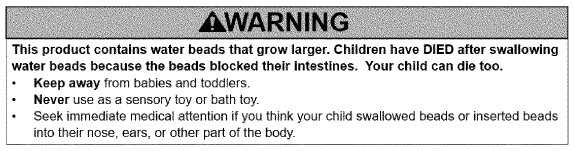
The Commission proposes requiring marking, labeling, and instructional literature requirements for all products within scope of the NPR and seeks comment on format, location, and content requirements of proposed warnings. (See Figure 1.)
Some water bead toys or toys containing water beads provide instructional literature, such as manuals for use. Instructions or other literature accompanying a water bead product, when provided, shall include directions for use, including the relevant warnings from Figure 1. The NPR proposes that instructional literature shall include the same warning labels that the NPR proposes for product packaging, with similar formatting requirements, though the literature does not need to be in color.
3. Use of Information Technology
To address the hazard posed, the proposed rule requires warnings and labeling requirements for water bead toys and packaging of toys containing water beads. On-product warnings are not digital in nature; however, CPSC staff utilizes appropriate forms of information technology, such as electronic communication, to reduce unnecessary burden.
4. Non-duplication
The information obtained through this collection is unique and is not already available for use or adaptation from another source.
5. Burden on Small Businesses
This information collection would have a significant impact on a substantial number of small entities, primarily from redesign costs in the first year of the collection.
To reduce the impact of the final rule on small firms, CPSC provides a variety of resources to help both new and experienced small businesses learn about safety requirements that apply to consumer products, including the CPSC Regulatory Robot, small business education videos, and the Small Business Ombudsman. Many of these resources can be accessed online at: https://www.cpsc.gov/Business--Manufacturing/Small-Business-Resources. Small firms can reach the Small Business Ombudsman by calling (888) 531-9070.
6. Less Frequent Collection
Based on National Electronic Injury Surveillance System (NEISS) data, CPSC estimates 6,300 injuries (sample size = 250, coefficient of variation = 0.27) related to water beads were treated in U.S. hospital emergency departments over the six-year period from 2017 through 2022. Of the 250 sample NEISS cases, none were fatal. About 42 percent of the estimated injuries involved children ages 2 through 4 years old, while about 15 percent of the estimated injuries involved children under the age of 2 years old. The youngest child was 7 months old.
If the information collection is conducted less frequently this could reduce the effectiveness of the proposed rule.
7. Paperwork Reduction Act Guidelines
This collection of information does not require collection to be conducted in a manner inconsistent with the guidelines delineated in 5 CFR 1320.5(d)(2).
8. Consultation and Public Comments
Part A: PUBLIC NOTICE
A 60-Day Federal Register Notice (FRN) for the collection published on Monday, September 9, 2024. The 60-Day FRN citation is 89 FRN 73024. The public will submit comments by November 8, 2024.
Pursuant to 44 U.S.C. 3506(c)(2)(A), the Commission invites comments on:
whether the collection of information is necessary for the proper performance of CPSC’s functions, including whether the information will have practical utility;
the accuracy of CPSC’s estimate of the burden of the proposed collection of information, including the validity of the methodology and assumptions used;
ways to enhance the quality, utility, and clarity of the information to be collected;
ways to reduce the burden of the collection of information on respondents, including the use of automated collection techniques, when appropriate, and other forms of information technology; and
the estimated burden hours associated with label modification, including any alternative estimates.
Part B: CONSULTATION
Building on staff’s continued collaboration with ASTM, CPSC staff is participating in voluntary standard activities related to toy safety. CPSC staff is currently working with the ASTM F15.22 Toy Safety Subcommittee to develop performance requirements for ASTM F963 Standard Consumer Safety Specification for Toy Safety. For additional information visit https://www.cpsc.gov/Regulations-Laws--Standards/Voluntary-Standards/Topics/Toys.
9. Gifts or Payment
No payments or gifts are being offered to respondents as an incentive to participate in the collection.
10. Confidentiality
A Privacy Act Statement is not required for this collection because we are not requesting individuals to furnish personal information for a system of records.
A System of Record Notice (SORN) is not required for this collection because records are not retrievable by PII.
A Privacy Impact Assessment (PIA) is not required for this collection because PII is not being collected electronically.
11. Sensitive Questions
No questions considered sensitive are being asked in this collection.
12. Respondent Burden and its Labor Costs
We estimate the burden of this collection of information as follows: (See table 1.)
Table 1: Estimated Annual Reporting Burden
Burden Type |
Number of Respondents |
Frequency of Response |
Total Annual Responses |
Hours per Response |
Total Burden Hours |
Labeling and instructions |
30 |
1 |
30 |
2 |
60 |
This estimate is based on the following: CPSC estimates there are 30 suppliers that would respond to this collection annually, and that the majority of these entities would be
considered small businesses. CPSC assumes that on average each respondent that reports annually would respond once, as product models for water beads are brought to market and new labeling and instruction materials are created, for a total of 30 responses
annually (30 respondents × 1 response per year). CPSC assumes that on average it will take 1 hour for each respondent to create the required label and one hour for them to create the required instructions, for an average response burden of 2 hours per response. Therefore, the total burden hours for the collection are estimated to be 60 hours annually (30 responses × 2 hours per response = 60 total burden hours).
CPSC estimates the hourly compensation for the time required to create and update labeling and instructions is $41.55.1 Therefore, the estimated annual cost of the burden requirements is $2,493 ($41.55 per hour × 60 hours = $2,493).
Based on this analysis, the proposed information collection would impose a burden to industry of 60 hours at a cost of $2,493 annually.
13. Respondent Costs Other Than Burden Hour Costs
No operating, maintenance, or capital costs are associated with the collection.
14. Cost to the Federal Government
The estimated annual cost of the information collection requirements to the Federal Government is approximately $4,774, which includes 60 staff hours to examine and evaluate the information, as needed, for CPSC’s compliance activities. This is based on a GS-12, step 5 level salaried employee. The average hourly wage rate for a mid-level salaried GS-12 employee in the Washington, DC metropolitan area (effective as of January 2024) is $53.87 (GS-12, step 5). This represents 67.7 percent of total compensation (U.S. Bureau of Labor Statistics, “Employer Costs for Employee Compensation,” June 2024, Table 2., percentage of wages and salaries for all civilian management, professional, and related employees: https://www.bls.gov/news.release/archives/ecec_09102024.pdf). Adding an additional 32.3 percent for benefits brings average annual compensation for a mid-level salaried GS-12 employee to $79.57 per hour. Assuming that approximately 60 hours will be required annually, this results in an annual cost of $4,774 ($79.57 per hour × 60 hours = $4,774.20).
15. Reasons for Change in Burden
This is a new collection with a new associated burden.
16. Publication of Results
The results of this information collection will not be published.
17. Non-Display of OMB Expiration Date
We are not seeking approval to omit the display of the expiration date of the OMB approval on the collection instrument.
18. Exceptions to “Certification for Paperwork Reduction Submissions”
We are not requesting any exemptions to the provisions stated in 5 CFR 1320.9.
1 U.S. Bureau of Labor Statistics, ‘‘Employer Costs for Employee Compensation,’’ September 2023, Table 4, total compensation for all sales and office workers in goods-producing private industries: https://www.bls.gov/news.release/archives/ecec_12152023.pdf.
| File Type | application/vnd.openxmlformats-officedocument.wordprocessingml.document |
| File Modified | 0000-00-00 |
| File Created | 0000-00-00 |
© 2025 OMB.report | Privacy Policy